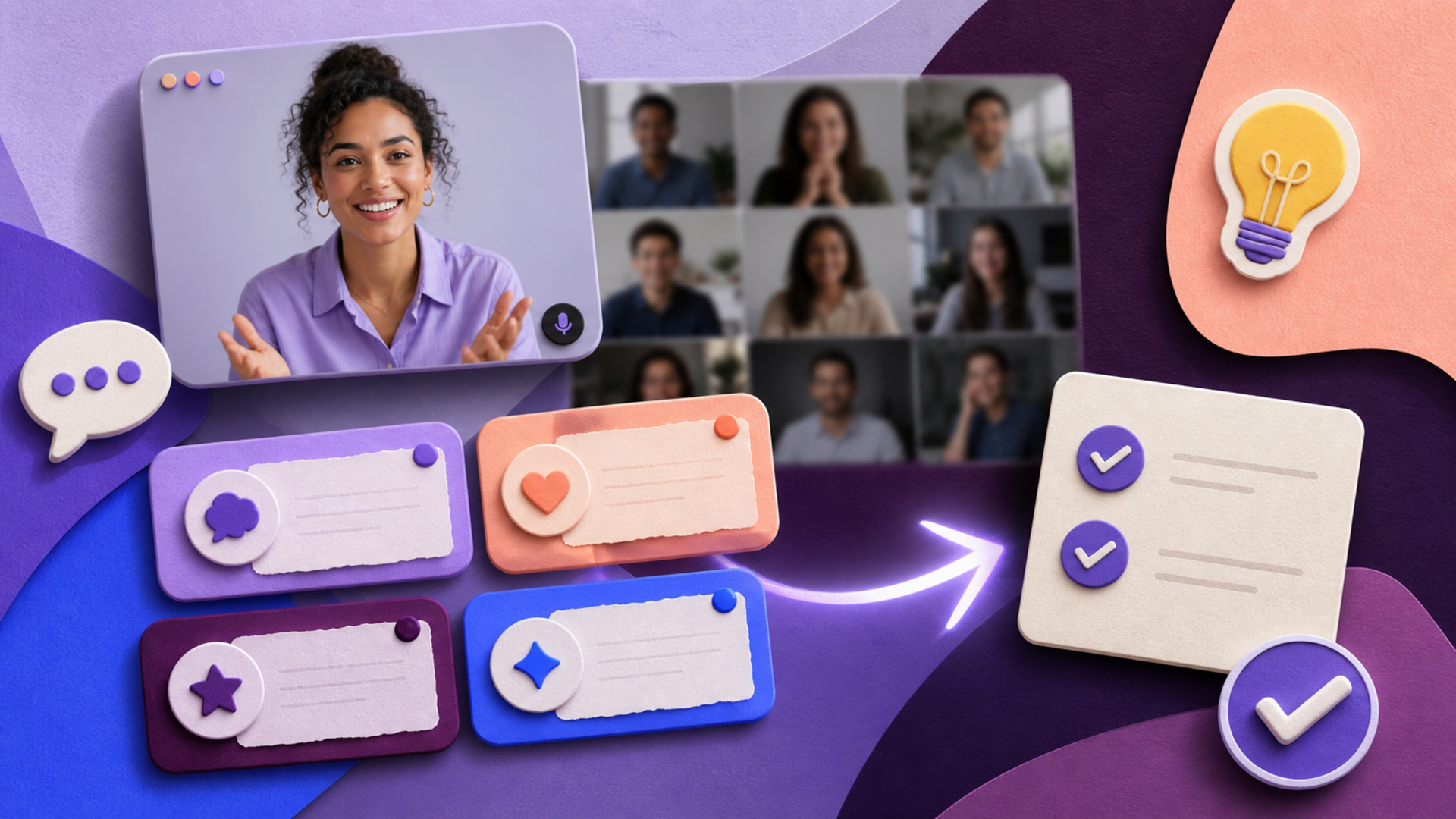
Anonymous questions for webinars solve a different problem from anonymous questions at a physical event.
The audience is not simply quiet.
It is distributed.
Some attendees are on camera.
Many are not.
Some are listening while working.
Some joined ten minutes late.
Some are watching from another time zone.
Some are following the slides on a small screen.
Some will only see the replay after the live question window has closed.
That creates what a webinar host can think of as question debt.
Every unexplained term, skipped step, untested claim and unanswered audience question adds to the debt.
If the host clears enough of it during the session, the webinar feels coherent.
If the debt grows, the final Q and A becomes a frantic ten-minute queue.
Then the host ends the call and the unanswered questions vanish with the meeting window.
Webinar platforms already treat Q and A as a distinct workflow. Microsoft Teams currently supports moderated Q and A, anonymous posts and multiple Q and A managers in webinars and town halls. Zoom Webinar currently supports anonymous questions, live or written answers, upvoting and post-event Q and A reports.
Those tools confirm an important design principle.
Questions need management across the event lifecycle.
A Vibebo question link can sit alongside the live webinar and stay available before, during and after the broadcast. That continuity gives quieter attendees and replay viewers the same simple route to add the question they were holding, even after the live Q and A window has ended.
Anonymous questions for webinars should start before the broadcast
Registration is the first chance to learn what the audience expects.
Most webinar registration forms ask for identity and logistics.
Name.
Email.
Company.
Job title.
Those fields help organise attendance.
They do not necessarily help the presenter understand what the audience needs.
Add a separate editorial question before the session.
“What do you most need this webinar to make clearer?”
That answer can expose three useful things.
Knowledge level.
Decision context.
Anxiety.
A beginner may ask what a term means.
A practitioner may ask about an edge case.
A buyer may ask whether the method works at their scale.
A manager may ask how to implement the idea with a reluctant team.
Those questions should change the preparation.
If twenty people ask about implementation and the deck spends thirty minutes on definitions, the mismatch is visible before the first slide.
Useful pre-webinar questions include:
1. What do you already understand about this topic?
2. What is still confusing?
3. What practical decision are you hoping the session will help you make?
4. Which example would make the topic feel relevant to your situation?
5. What are you worried the presenter may skip?
6. What question would you hesitate to ask with your name attached?
Do not turn registration into an examination.
One strong open question may be enough.
The goal is to shape the session, not make people earn entry.
Separate the presenter from the question manager
A webinar host cannot present, watch chat, read questions, judge relevance, manage time, troubleshoot audio and notice audience confusion equally well.
The larger the webinar, the more useful it becomes to separate roles.
Presenter.
Moderator.
Question manager.
The same person can hold two roles in a small session, but the responsibilities should still be explicit.
Microsoft’s current Teams guidance reflects this by allowing organisers, co-organisers and, in webinars, eligible presenters to manage Q and A. Zoom likewise lets hosts, co-hosts and panellists answer webinar questions.
A question manager should do more than read the next item.
They should classify what is arriving.
Clarification.
Evidence.
Application.
Technical issue.
Repeat question.
Off-topic question.
Question requiring a private or specialist route.
Question that cannot be answered safely or accurately live.
This prevents the loudest or newest question from automatically becoming the next question.
Keep questions open while the idea is fresh
Webinar audiences lose questions quickly.
A presenter says something surprising at minute twelve.
The attendee thinks:
“How would that work if our team is remote?”
The slide changes.
A new example begins.
The attendee waits for the host to pause.
Twenty minutes later, they cannot remember the exact point.
Do not rely entirely on the final Q and A.
Invite questions while the content is happening.
Useful prompts include:
7. Which point needs another example?
8. What term did we move past too quickly?
9. Which claim needs evidence or a source?
10. What would work differently in your context?
11. Which step sounds harder in practice than it looks on the slide?
12. What exception should we discuss?
13. What part would you not know how to start tomorrow?
14. What question are you holding because it feels too basic?
That last question is particularly important in professional webinars.
The knowledge level is often invisible.
People may be afraid that asking for a definition signals inexperience.
An anonymous route can lower that social cost.
Do not let popularity decide the whole Q and A
Teams and Zoom can support upvoting in Q and A.
That is useful.
If fifty people support one question, the host should notice.
But upvotes answer one question only.
Which submitted questions do participating attendees want answered?
They do not tell the host which question is most important for safety, accuracy, accessibility or the learning objective.
A specialist question may receive three votes because only three people understand the risk.
A beginner question may receive few votes because beginners are reluctant to interact at all.
A question about a minority use case may matter precisely because most attendees are not affected.
Use popularity as one signal.
Then apply editorial judgement.
A practical order is:
Questions that correct a dangerous or material misunderstanding.
Questions blocking the main learning objective.
Questions many attendees share.
Questions that test a major claim.
Questions that help apply the idea.
Questions that are interesting but optional.
The host does not owe every question live airtime.
They do owe the audience a clear rule for what happens next.
Treat unanswered questions as a queue, not a failure
A strong webinar can generate more good questions than time allows.
That is a success with an operational consequence.
The consequence is a queue.
At the end of the session, do not say:
“Sorry we could not get to everything.”
Then close the tab.
Say what happens to the queue.
Some questions can become a written FAQ.
Some need links to source material.
Some deserve a follow-up webinar.
Some should be answered privately.
Some reveal that the original webinar did not explain a key section well enough.
Some are outside the presenter’s expertise.
Some contain confidential information and should not be repeated publicly.
Question debt becomes useful when it changes the follow-up.
For example:
“We received several questions about implementation in small teams. We did not have enough time to answer them properly, so the follow-up note will cover the first three steps and the assumptions behind them.”
That is much stronger than a generic recording email.
Build follow-up from questions, not only from slides.
Make replay viewers part of the audience
A webinar replay creates a second audience.
The live audience had timing, chat and Q and A.
The replay audience has pause, rewind and a completely different problem.
They cannot interrupt.
If the only question route disappears when the live platform closes, the replay becomes one-way content.
Keep a question route available in the replay page, follow-up email or accompanying resources.
Ask:
15. What became unclear while watching the replay?
16. Which answer depended on something said earlier that you could not find?
17. What would you ask the presenter if you had been there live?
18. Which part deserves a short follow-up explanation?
19. What example would help you apply this after watching?
20. What question should be carried into the next webinar?
This is where webinar question debt differs sharply from physical event Q and A.
The audience can continue growing after the event date.
The question process should account for that.
Do not mix every webinar type together
A webinar can have very different purposes.
Education.
Lead generation.
Customer onboarding.
Product demonstration.
Policy briefing.
Community update.
Expert discussion.
The questions should follow the purpose.
If the webinar is a product demo, Article 35’s purchase-uncertainty questions are a better framework.
If the webinar is a workshop with an explicit learning outcome, Article 38’s understanding and misconception questions are more appropriate.
If it is a broad public event, Article 36 covers general event participation.
This article owns the webinar-specific problem.
Distributed attention and questions that survive beyond the live broadcast.
Keep the anonymous route within sensible boundaries
An anonymous question box is not the right place for everything.
Do not invite people to submit emergencies, safeguarding concerns, formal grievances, confidential legal matters or sensitive account information into an ordinary webinar Q and A route.
If the webinar covers health, finance, law or another high-stakes subject, make it clear that general questions are not personalised professional advice.
Moderation should remove abuse, duplicates and material that cannot responsibly be discussed.
It should not remove a fair question because the presenter finds it uncomfortable.
A question such as:
“What evidence supports that claim?”
is not hostile.
Neither is:
“What would make this advice fail?”
Good webinars need room for both.
Keep one question route open before, during and after
Vibebo can give a webinar one anonymous question route that stays useful across the whole event instead of disappearing when the live Q and A closes.
Before the broadcast, the host can share a personal profile link in the registration confirmation or event page with a prompt such as:
“What do you most need this webinar to make clearer?”
During the session, the same link or QR code can appear on a slide with a shorter prompt:
“What is still unclear?”
After the webinar, the link can stay in the replay or follow-up email:
“What question did we not answer?”
Viewers can open the shared link in a browser and send an anonymous message without creating a Vibebo account. That gives people who stay off camera, arrive late or watch the replay later a consistent way to add the question they were holding.
For the webinar team, a Shared Channel can give named viewers and managers access to the same stream of ordinary questions. A moderator can sort them into clarification, evidence, application and follow-up, while the presenter concentrates on the session.
The unanswered questions then become useful content rather than leftovers.
A repeated implementation question might become a follow-up guide. A basic question that several people were embarrassed to ask may deserve a clearer explanation in the next webinar. A replay viewer may surface the question that nobody thought of during the live broadcast.
Vibebo can also extend selected questions into a public response. When an incoming question is suitable for wider discussion, the recipient can write a reply and publish it with the original anonymous prompt to VibeboX or Pulse. Signed-in people can react, comment, save, follow and share.
That creates a simple webinar loop:
Ask before the session.
Collect while people are listening.
Keep listening after the replay goes out.
Answer the strongest shared questions where others can benefit.
The result is a Q and A process that is not trapped inside the final ten minutes of the broadcast. Questions can shape preparation, improve the live explanation and continue into the follow-up.
Keep personal, confidential or highly specific details in the private inbox. Use the public reply route for the questions that are useful to the wider audience.
Run a before, live, after question loop
A webinar team can begin with three prompts.
Before the session:
“What do you most need this webinar to make clearer?”
During the session:
“What are you still unsure how to apply?”
After the session:
“What question remains unanswered?”
Then classify the answers.
Clarification.
Evidence.
Application.
Follow-up.
Specialist or private route.
The host can use the live questions to adjust the webinar, the unanswered questions to build the follow-up and the replay questions to improve the next session.
Anonymous questions for webinars should not be treated as a feature bolted onto the final slide.
They are part of the content system.
The strongest webinar does not simply finish its deck on time.
It notices where the audience’s understanding is unfinished and gives those questions somewhere to continue.